
Today we have some information for you on a topic that’s quite controversial—and one that actually sends shivers down our spines. We’re talking about testing cosmetics on animals. However, we’ve promised ourselves to approach this issue purely pragmatically, so that we can present you with the most important facts, which you can then compare with your own knowledge and form your own opinion—or perhaps even change it. First, a quick overview of the facts in graphic form:
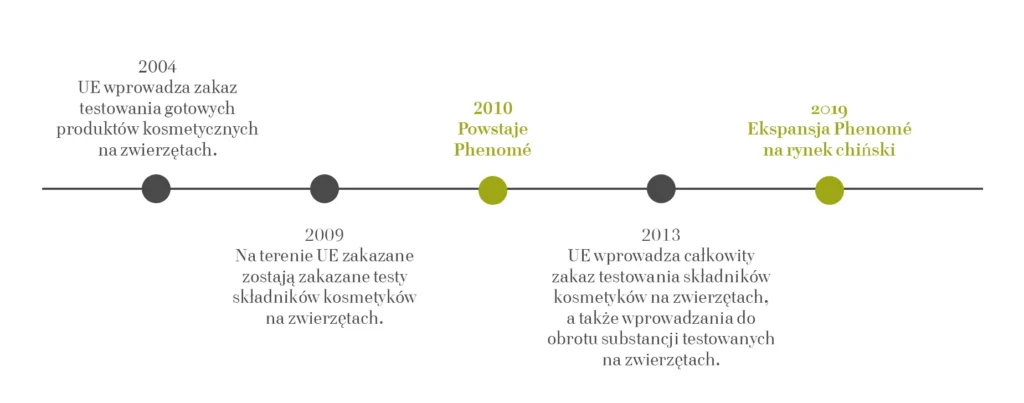
Before we discuss our latest venture—our Chinese adventure—we’d like to share one more piece of information that we didn’t include on the timeline. Why? Because it’s not a point in time, but a way of thinking that is inextricably linked to our company’s philosophy and embedded in the DNA of the Phenomé brand. To put it simply: we have never tested, do not test, and will never test cosmetics on animals! An integral part of Phenomé’s operations are our unwavering values, which we strive to weave into every business process. We are transparent and have nothing to hide. From the very beginning, we wanted to create cosmetics that would embody our ideals, that would be part of what matters to us. Quite simply, we cannot imagine any stage of production or trade contributing to animal suffering.
There is a widespread belief that selling cosmetics in China is synonymous with animal cruelty. It is commonly assumed that all cosmetics sold there must undergo mandatory animal testing in order to be approved for sale. This is a kind of generalization that, from Phenome’s perspective, is deeply unfair and misleads our consumers. That is why we want to clarify this for you and dispel any doubts that Phenome, by selling cosmetics on the Chinese market, has ever participated in such a barbaric practice as animal testing.
When it comes to the wholesale and retail sale of cosmetics in mainland China, Chinese law does indeed require that cosmetics imported into China undergo animal testing. However, there are solutions that allow cosmetics to be sold on the Chinese market in accordance with the “cruelty-free” principle. We have opted for two such solutions:
We’ve already shared a few facts about our brand’s history with you, introduced you to the ins and outs of doing business in China, and now we’d like to talk about how to interpret information found online. We make no secret of our enthusiasm for the opportunities the Internet offers us. We consider ourselves beneficiaries of the Internet and can’t imagine our lives without access to it. This post wouldn’t exist if it weren’t for the Internet 🙂
Thanks to internet access, we can communicate and constantly access information—including details about cosmetics, their ingredients, origins, effectiveness, and so on. As a global source of information, the internet has its drawbacks alongside its undeniable advantages. It’s important to identify and verify these. For example, lists of companies that do not test their products on animals are outdated and incomplete, as they include companies that have opted to undergo the burdensome, time-consuming, and bureaucratic procedures required to obtain certification. So when reading these lists, let’s remember that no cosmetics manufacturer in the EU tests its products on animals, because it is illegal and barbaric.