
How is this vitamin used in the cosmetics industry? How does the vitamin C used today differ from the one that was known forty years ago?
Cosmetics containing vitamin C weren’t invented 5 or even 10 years ago. Vitamin C was already being used in the cosmetics industry 40 years ago, but its form was quite different from what’s found in creams and serums today. Our mothers and grandmothers used products containing ascorbic acid, the simplest form of vitamin C. “Unfortunately, it is very unstable. It is a substance highly susceptible to oxidation, but also to degradation under the influence of light or temperature,” says Monika Krzyżostan, head of Dr. Koziej’s laboratory. This is not the only drawback associated with the vitamin C-containing cosmetics of that era. They were not only less effective but also discoloring. They turned both the skin and materials yellow, which was unfortunately due to the color of ascorbic acid. Above all, however, this form of vitamin C was unstable, and this prevented manufacturers from creating cosmetics that could actually have an anti-aging effect. “If a manufacturer declared an ascorbic acid content of 10 or 15%, because that’s how much they actually added during the formulation and production stages, unfortunately, the final product likely didn’t contain 10 or 15% ascorbic acid, but significantly less. The technological processes involved in the production of the cosmetic alone caused the ascorbic acid to break down, meaning it lost its properties.” So what sets today’s vitamin C cosmetics apart from those available 40 years ago?
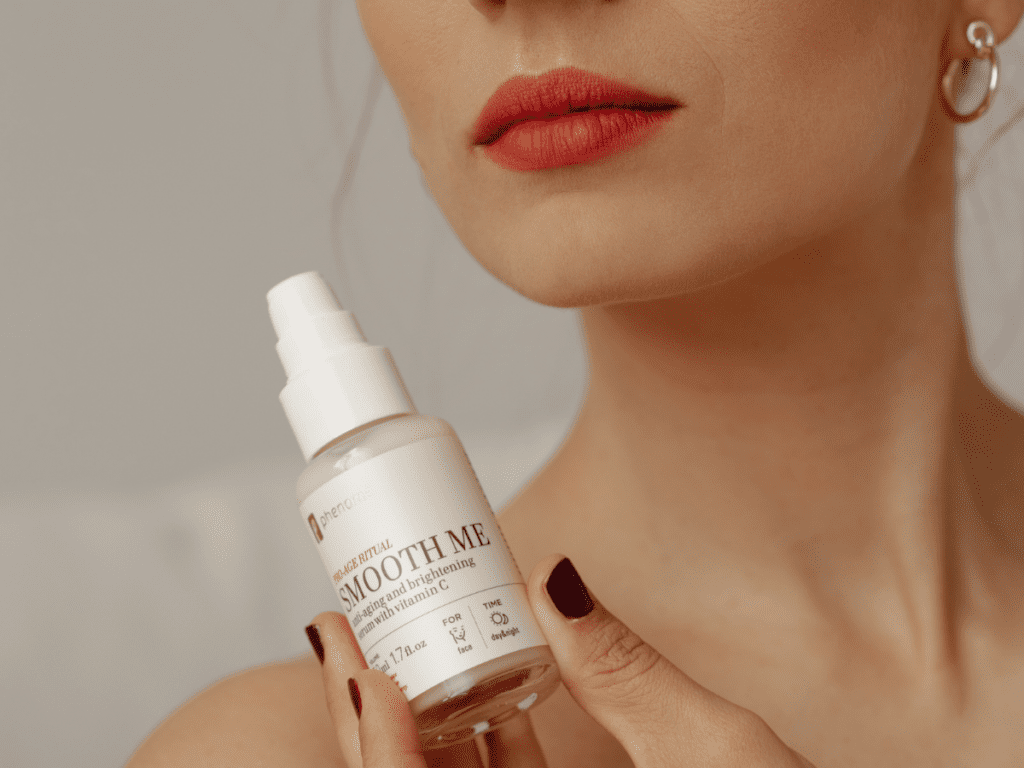
As early as 40 years ago, it was known that vitamin C was a valuable ingredient worth using in cosmetics. However, the technology needed to ensure the compound’s stability was not yet available. Fortunately, things are completely different now. New forms of compounds, such as vitamin C esters (palmitate) or ascorbyl glucoside, ensure greater stability and, consequently, effective action. “At this point, we no longer need to use 10 or 15% vitamin C. Stability has been improved to such an extent, and these chemical forms have been developed, that even concentrations as low as 2% are sufficient for the vitamin C in the cosmetic to be effective (…) and to actually have an active effect on the skin.” This is exactly the case with the new Phenomé serum from the PRO-AGE Ritual series. A 2% concentration, which would once have seemed ridiculously low and would indeed have had no effect on the skin, is now sufficient and effective
The Phenomé serum from the Pro Age line contains ascorbyl glucoside—one of the new forms of vitamin C, which is highly stable. It is a substance produced biotechnologically through an enzymatic process. “The starting materials are ascorbic acid and potato starch—which is rich in glucose,” – says Monika Krzyżostan, emphasizing that it is a naturally derived substance approved by COSMOS and Ecocert. Currently, it is the only form of vitamin C of natural origin. Ascorbyl glucoside is obtained through processes compliant with green chemistry, which do not harm the natural environment because they do not generate harmful waste. Seeking out ingredients that are natural and approved by institutions such as Ecocert is one of the key elements of Phenomé’s philosophy, as well as that of Monika Krzyżostan, who creates formulas primarily for natural products and promotes sustainable development in the cosmetics industry.
The eco-friendliness of ascorbyl glucoside is not the only advantage of this substance. It is also highly stable and has been thoroughly tested by the manufacturer, who conducted a vast amount of research to confirm its effectiveness. Studies on fibroblasts (cells isolated from the skin) and on volunteers have confirmed a range of vitamin C’s properties. First and foremost, it is characterized by strong antioxidant activity and the ability to boost collagen synthesis, which slows down the skin’s aging process. It also inhibits melanogenesis, or the formation of pigment in the skin. This form of vitamin C therefore has a skin-brightening effect and thus helps combat discoloration and a dull complexion. Further studies on this substance have shown that it provides protection against UV radiation. Therefore, it is recommended that ascorbyl glucoside be added to sunscreen creams or applied under sunscreen, which can provide additional protection for the skin. Vitamin C also has anti-inflammatory properties, which are linked to its antioxidant effects. “If vitamin C inhibits the production of free radicals—or rather, sweeps them away from our cells—then inflammatory processes do not develop [in the skin]. Free radicals are responsible, among other things, for the inflammatory process, but also for DNA mutations,” emphasizes Monika Krzyżostan. People struggling with irritation, dilated capillaries, or erythema can count on vitamin C to soothe inflammation and calm the skin.
Many women wonder whether it is safe to use cosmetics containing vitamin C during pregnancy or while breastfeeding. “Of course it is,” says Monika Krzyżostan. “It is a safe vitamin, and pregnant women can definitely use it.” After all, vitamin C is also taken orally in the form of supplements and food products, even during pregnancy. It poses no risk to either the mother or the baby. Questions like these don’t come out of nowhere, though. They are likely linked to popular myths, the most well-known of which is the one claiming that you cannot go out in the sun when using cosmetics containing vitamin C. This is, of course, untrue—vitamin C in cosmetic products is actually recommended as additional protection against UV rays. However, it cannot be ruled out that the original form of the vitamin—ascorbic acid, used in cosmetics 40–30 years ago—did cause irritation when exposed to the sun. Current forms of vitamin C, including the ascorbyl glucoside used in Phenomé cosmetics, are safe for the skin of mothers, nursing women, older and younger people who love sunbathing, and those with problematic skin. It is one of the most versatile and best-studied vitamins. You certainly shouldn’t be afraid of it.
Used in the morning and evening, whether in creams or skincare serums, you simply can’t use too much vitamin C. “I would even recommend using it in the morning and evening,” says Monika, “Our skin needs antioxidants around the clock.” It’s therefore a good idea to use vitamin C-based skincare products as a staple of your routine, without worrying about overdoing it.
The popularity of vitamin C is well-deserved. It’s an excellent active ingredient in cosmetics, one that our mothers were already familiar with. And today, it’s much more effective than it was 30 years ago.