
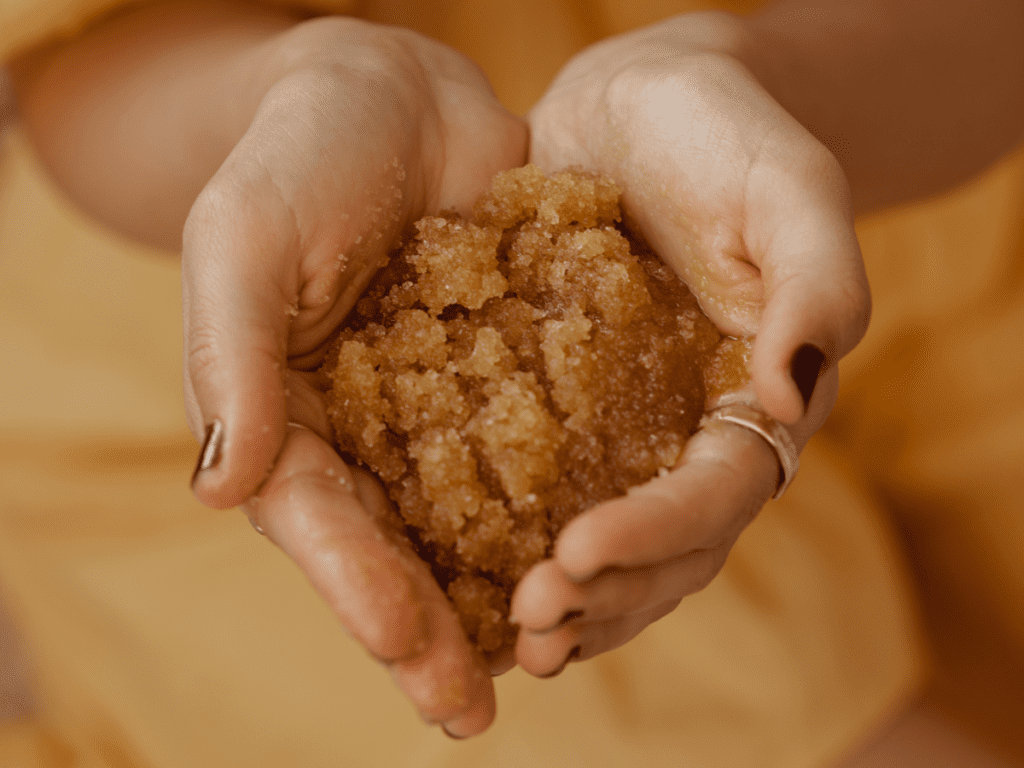
Nature has equipped us with a natural process for shedding dead skin cells. This clever mechanism works very well when we’re young. Over time, however, nature becomes a bit forgetful—it doesn’t remove dead cells in a timely manner and gets a little lazy. So we need to give it a nudge, specifically by using a scrub that’s suited to our skin type.
This type of skincare has been used since the days of Ancient Egypt. Today, however, as modern cosmetic technologies continue to advance, new types of peels and their variations are constantly emerging. Some of them can be safely performed at home, while others, such as cavitation or chemical peels, are best done at a beauty salon. Some work deeply, while others, such as enzyme peels, work gently, cleansing only the outer layer of the skin.
The use of exfoliants should be viewed primarily as an essential part of your skincare routine, stimulating the skin’s natural renewal process. Removing dead skin cells through exfoliation supports the skin’s natural exfoliation process. Furthermore, using exfoliants prepares the skin to absorb the ingredients found in creams, masks, and serums. Exfoliants facilitate the penetration of active ingredients deep into the skin, ensuring optimal regeneration.
Shedding dead skin cells is a physiological process, which means it is a completely natural function of the body. Our skin consists of an inner layer, called the dermis, and an outer layer, the epidermis. The outermost surface of the epidermis, known as the stratum corneum, is composed entirely of dead cells.
It turns out that despite their “dead” nature, it is the cells of the epidermis that make us look healthy and rested—or tired and drained of energy. As we age, the skin’s exfoliation process slows down, causing the skin to become drier and take on a grayish tone, which makes us look older—yet we all want that fresh, radiant glow. Exfoliation therefore has many useful applications, ranging from general skin improvement to rejuvenation or the alleviation of symptoms of skin conditions.
Currently, the four most popular types of scrubs are:
You can easily perform the first two exfoliations in the comfort of your own home using readily available skincare products. For the last two, it’s best to make an appointment at a professional spa. Below, we explain how they differ from one another and which skin types they’re best suited for.
The first group consists of the least invasive enzyme peels. They are particularly recommended for sensitive skin (though they can be used successfully on all skin types). They are the safest type of peel. Unlike mechanical and chemical peels, they work gently, removing dead skin cells without the risk of irritation.
Phenomé is an excellent product of this type. It’s a perfect exfoliator for sensitive or acne-prone skin because it’s completely non-abrasive—it doesn’t scrub the skin’s surface with any particles, so it doesn’t cause irritation or disrupt the skin’s pH balance. It also works wonderfully as an exfoliator for skin prone to broken capillaries.
The secret behind its exfoliating effect lies in plant-derived enzymes that safely dissolve the upper layers of the epidermis. Many of these enzymes also have additional beneficial properties—for example, papain brightens the skin, and bromelain accelerates the healing of wounds that often occur with acne. In this way, a good, natural enzyme peel not only cleanses and smooths but also soothes.
Fun fact: Trichological scalp scrubs, which are becoming increasingly popular, are available in both enzymatic and mechanical forms. It’s a good idea to check their ingredients.
This type of cosmetic product or treatment mechanically removes the upper layers of the epidermis by scrubbing the skin’s surface with a suitable exfoliating agent. It is not recommended for sensitive or couperose skin, but it is certainly effective for normal and combination skin. A natural rice powder scrub and a sugar scrub are excellent choices for facial exfoliation.
When it comes to body scrubs, we usually opt for popular options like coffee scrubs or sugar scrubs, which come in coarse or fine-grained varieties. In addition to coffee beans or sugar crystals, a good scrub also contains a blend of organic plant oils that visibly nourish and moisturize the skin. A good example is our NOURISHING Sugar Body Scrub, which leaves just such a pleasant film on the skin.
Importantly, for oily skin, a coarse-grained coffee, sugar, or salt scrub works best, while for combination or normal skin, a fine-grained scrub is more suitable.
Fun fact: Dermabrasion and microdermabrasion, which are performed at beauty salons, are also types of mechanical exfoliation.
Chemical peels get their name from laboratory-developed exfoliating agents. These are most often acids, which is why “acid peels” is another common name for this type of treatment. Different types of chemical peels are named after specific acids, such as the mandelic acid peel, which gets its name from mandelic acid.
Importantly, chemical peels are based on three different acids, each with a different strength:
Since chemical peels are quite invasive and carry a risk of burning or weakening the skin’s protective barrier, it is best to have them performed by a specialist at a beauty salon.
Chemical peels are most commonly used as deep exfoliants for mature skin because they help smooth out wrinkles and reduce discoloration. People with acne often opt for them as well, since they aid in treating the condition.
Fun fact: If you decide to get an acid peel, remember to avoid the sun and use sunscreen for a few days after the procedure.
The last peel on our list is the cavitation peel. Like a chemical peel, it is classified as a so-called deep peel, reaching the deeper layers of the skin. Unlike chemical peels, however, it is considered extremely safe even for sensitive skin, and what’s more, it is completely painless. It is a very popular treatment offered by most beauty salons.
Cavitation peeling is performed using a special machine that emits ultrasonic waves at a frequency of 28 kHz. Since the device emits over 28,000 pulses per second, when these waves strike the skin, they create cavitation bubbles on its surface, which then burst. This process exfoliates successive layers of the epidermis.
Fun fact: We can observe the phenomenon of cavitation every day in our surroundings. One example is the hissing sound we hear when we turn on a kettle.
Our introduction to the topic of exfoliants focused primarily on facial scrubs. We concentrated on the skin on the face—the most sensitive area and the one most exposed to the sun—which requires special care. But of course, we haven’t forgotten about the rest of the body—we’ve saved body scrubs (such as the NOURISHING Sugar Body Scrub) for last.
The skin on your body isn’t as delicate as the skin on your face. It responds very well to mechanical exfoliation. At Phenomé, we’ve prepared three body scrubs for you. Our NOURISHING Sugar Body Scrub is a deliciously fragrant product made with brown sugar that exfoliates and stimulates renewal, while leaving the skin moisturized and silky smooth. We also have two scrubs designed for specific body parts: a hand scrub and a foot scrub. The first one, our natural volcanic rock pumice, exfoliates, removes dead skin cells, and leaves a pleasant feeling of lightness. (We really love that minty coolness on our feet.) 🙂 The second scrub, designed for the hands, is gentler and contains fine sugar crystals that, combined with essential oils, nourish the skin while exfoliating and moisturizing.
Shedding dead skin cells is a natural physiological process essential for skin regeneration. As we age, this process becomes less efficient, and the skin tends to become dry. It is therefore worth stimulating the skin through exfoliating cosmetic treatments, i.e., scrubs. These are, in fact, the absolute foundation of skincare and an essential step in preparing the skin to absorb the active ingredients found in creams and lotions. It is important that they are properly selected for your skin type and needs.